International diversification
Building an additional base can reduce dependence on one political, economic or regulatory environment.
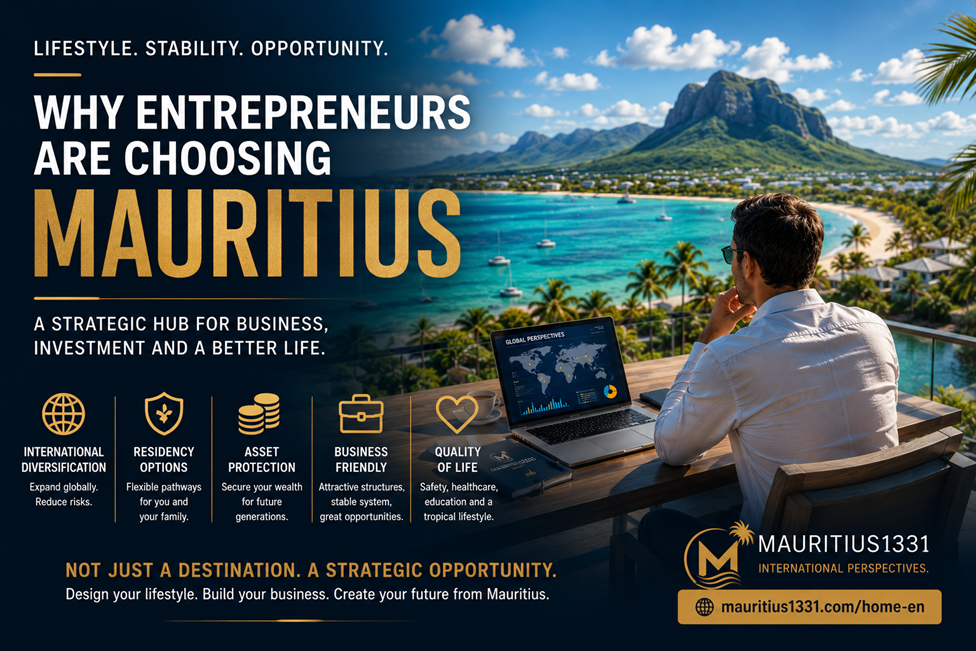
Successful relocation is no longer only about finding a warmer climate or reducing expenses. Entrepreneurs, investors and internationally mobile families are increasingly searching for a place where business opportunity, legal stability, personal freedom and quality of life can coexist.
Mauritius attracts attention because it offers an unusual combination: a globally connected economy, an established international business sector, a multicultural society, strong private services and a lifestyle that can support both ambition and family life.
A base for international entrepreneurship and regional activity.
Opportunities across property, companies and long-term diversification.
Schools, healthcare, safety and a multicultural environment.
More space, outdoor living and a different relationship with time.
For years, international success was measured primarily by revenue, career status, investment returns and business growth.
Those factors still matter. But globally mobile people increasingly ask a second set of questions: Where can we live safely? Where can our children grow up well? Where can we remain internationally connected? Where can business and lifestyle support each other rather than compete?
Mauritius is known internationally for its beaches and resorts. That image is real, but incomplete.
Behind the tourism sector is a diversified economy with financial services, professional services, technology, manufacturing, logistics, property, education, healthcare and international business activities.
Mauritius does not ask successful people to choose between ambition and quality of life. It offers the possibility of designing both together.
Entrepreneurs rarely relocate for one reason alone. The decision is usually a combination of market access, personal freedom, family considerations, regulation, taxation, lifestyle and long-term risk management.
Building an additional base can reduce dependence on one political, economic or regulatory environment.
Mauritius can support selected businesses operating between Africa, Europe, Asia and the wider Indian Ocean region.
The island has experience with cross-border investment, global companies and professional international services.
The relatively compact scale can make meetings, relationships, local travel and daily business coordination more manageable.
Entrepreneurs can remain professionally active while gaining more access to nature, sport, family time and outdoor living.
Mauritius is most relevant when real management, employees, decisions or regional functions are established locally.
A legally registered company is only one component. The larger question is whether the entrepreneur’s business, residence and daily life can genuinely operate from Mauritius.
Serious planning should clarify where customers are located, where work is performed, how banking will function, where employees are based and where management decisions are made.
Investors increasingly recognise that geographical diversification can be as important as asset-class diversification.
Mauritius may form part of a wider strategy involving property, regional business interests, African investment exposure, private wealth planning or a future residence base.
Approved property opportunities can combine lifestyle, rental potential and long-term personal use.
Investors may explore operating companies, partnerships, regional activities or selected local sectors.
Mauritius is frequently used as a platform for understanding and approaching opportunities across Africa.
Investment decisions may be coordinated with residence, family governance and future succession.
A residence can serve not only as an investment, but also as a future home and family base.
A well-planned investment can create choices without requiring immediate permanent relocation.
International buyers often begin with beachfront villas or luxury residences. The more important question is how the property fits the wider plan.
A home intended for holidays, rental income, future relocation or permanent family life may require very different locations, management arrangements and financial expectations.
An entrepreneur may be comfortable working internationally, but a successful family relocation requires more than a company, a residence permit and a house.
Families should assess curriculum, language, location, fees, school culture and long-term transition options.
Everyday medical care may be readily available, while complex treatment can require additional planning.
Parents often value a less anonymous environment, but neighbourhood selection and everyday awareness still matter.
Children and parents need realistic opportunities to build friendships and become part of local life.
Beaches, sports, hiking, nature and year-round outdoor activities can significantly change family routines.
A good relocation plan should preserve options for university, business expansion and future moves.
Mauritius can offer a high quality of life, but it is not a resort experience every day.
Long-term residents deal with traffic, humidity, property maintenance, administrative procedures, seasonal weather, imported-goods pricing and the limitations of a relatively small island market.
Mauritius works best for people who want to build a real life on the island, not recreate their former country under palm trees.
The tropical environment supports outdoor living, but regional climate differences should influence where you settle.
Air links connect Mauritius with Africa, Europe, the Middle East and Asia.
Modern telecommunications support remote work, international management and digital services.
A diverse population can make international families feel less isolated than in more culturally uniform destinations.
The island offers accessibility and community, but less anonymity and fewer specialised options than a global city.
Many residents value a lifestyle in which work, sport, nature and family can fit into the same day.
Mauritius offers different residence routes that may be relevant to investors, business owners, professionals, self-employed people and retirees, depending on the current legal criteria.
The appropriate route should match the person’s actual plans, business activity, investment, income and intended length of stay.
Founders who can manage international operations from a smaller, stable and globally connected base.
Investors seeking regional exposure and a respected base in the Indian Ocean.
Families prioritising safety, education, outdoor life and multicultural surroundings.
Entrepreneurs whose clients, teams and services can be coordinated internationally.
Buyers who want their residence, investment and lifestyle strategy to support each other.
People seeking a future base, rather than a short-lived tax or lifestyle experiment.
Mauritius cannot match the scale, choice and intensity of Dubai, Singapore, London or New York.
Some professions require labour markets, institutions or networks unavailable on a small island.
Imported products, specialist services and administrative procedures can require more patience.
Mauritius is unsuitable where there is no intention to establish real residence or commercial substance.
The compact environment can feel limiting to those who need constant urban variety.
Relocation becomes difficult when the expectation is to reproduce every aspect of the former home country.
Clarify whether the priority is business, investment, family life, retirement or a combination.
Review residence, business, property and investment requirements.
Understand obligations in Mauritius and every country being left or retained.
Compare climate, schools, commuting, healthcare and lifestyle.
Spend meaningful time outside a holiday setting before making permanent commitments.
Align company, banking, management and commercial substance.
Buy only after location, legal eligibility and long-term use are clear.
Plan schooling, healthcare, routines, integration and social life.
Adapt when business, family circumstances or legal rules change.
A buyer commits before understanding regional differences and daily travel patterns.
The family and lifestyle decision do not support the financial structure.
One partner sees opportunity, while the other experiences isolation.
Home and school are selected separately, creating exhausting daily commutes.
A holiday experience is mistaken for the reality of work, maintenance and administration.
The business remains fully controlled from another country without genuine local functions.
A fashionable address is selected without considering climate, traffic or practical needs.
Insurance, specialists and possible overseas treatment are not considered in advance.
The family remains socially disconnected and never builds a sustainable local routine.
The conversation about Mauritius is not only about moving country. It is about redesigning the relationship between work, wealth, family, time and personal freedom.
Where do you want your children to grow up? Where can your business continue to develop? Where can investments, residence and daily life support one another? What environment will still feel right in ten or twenty years?
For a growing number of entrepreneurs, investors and families, Mauritius is becoming part of that answer.
Understand company formation, substance, banking and regional opportunities.
Evaluate property, local opportunities and long-term diversification realistically.
Connect residence, location, family life and practical implementation.
Consider schools, healthcare, integration and the needs of every family member.
Separate attractive images from the realities of long-term island life.
Build a solution that remains workable beyond the first year of relocation.
Entrepreneurs may be attracted by international connectivity, regional African opportunities, business services, lifestyle and the possibility of establishing a genuine international base.
No. For many people, quality of life, family security, property, climate and international diversification are more important.
Mauritius offers several residence routes, subject to the applicable legal criteria and personal circumstances.
Foreign entrepreneurs can establish businesses, subject to company, immigration, licensing and sector-specific requirements.
Foreign purchasers may acquire eligible property through approved legal routes and developments.
Residence consequences depend on the property category, purchase value and current legal conditions.
It can be highly attractive for families, particularly where school, healthcare, housing and location are planned carefully.
Mauritius has private and international education options, but curriculum, fees, capacity and distance should be checked early.
Mauritius has public and private healthcare. Complex conditions may require specialist treatment locally or abroad, so insurance and contingency planning are important.
Mauritius is generally regarded as comparatively stable, but normal precautions, neighbourhood selection and property security remain important.
Costs vary significantly according to housing, schooling, imported products, transport and lifestyle expectations.
Many expatriates consider a car important, particularly when commuting between homes, schools and business locations.
There is no single best area. The north, west, centre, east and south offer different climates, infrastructure, communities and daily routines.
Potentially yes, provided the business model, connectivity, banking, tax position and operational substance are appropriate.
It can be, but returns depend on purchase price, location, project quality, rental demand, costs and resale conditions.
For many relocating families, renting first provides time to understand regions, traffic, climate and daily life.
The island has modern digital infrastructure, but immigration, tax and employer obligations must still be considered.
Dependent residence may be available under certain routes, subject to the applicable conditions.
Not automatically. Residence, exit taxation, property, companies and income in other countries require separate review.
Mauritius generally offers a smaller, greener and more family-oriented environment, while Dubai provides a much larger urban and commercial ecosystem.
The answer depends on regional access, climate, language, residence planning, lifestyle and business needs.
A longer stay outside a holiday setting is advisable, ideally including normal workdays, school visits and practical appointments.
Deciding from a holiday impression without testing daily life, location and family suitability.
Mauritius1331 provides strategic orientation and practical context. Binding legal and tax implementation requires qualified professionals.
Define why Mauritius is being considered and assess whether business, investment and family goals genuinely align.
Mauritius1331 helps entrepreneurs, investors and families understand the connection between business, investment, residence, property and long-term quality of life.
The strongest relocation is not based on one attractive benefit. It is based on a coherent plan that works professionally, financially and personally.