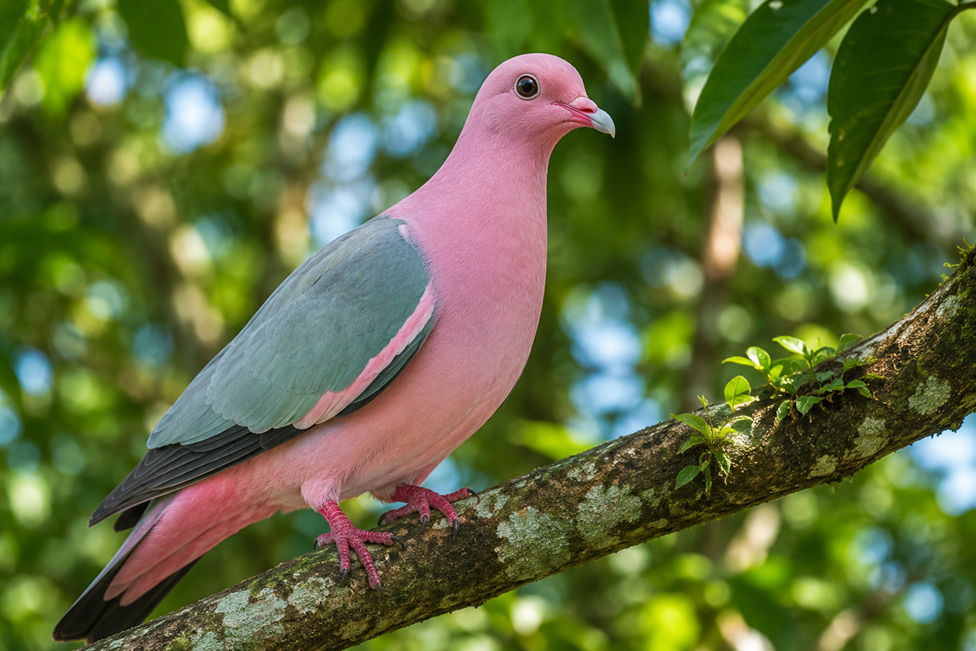
Pink Pigeon in Mauritius
A subtle forest bird whose survival became one of Mauritius' most important conservation stories and a reminder that recovery still requires long-term protection.
- The Pink Pigeon occurs naturally only in Mauritius
- Its colouring is a soft blush rather than vivid pink
- Native forest provides food and breeding habitat
- Introduced predators remain a serious pressure
- Recovery still depends on active conservation
A refined island endemic
The real Pink Pigeon is more subtle than its famous name suggests
Visitors sometimes expect a brightly coloured tropical pigeon. In reality, the Pink Pigeon is elegant and understated, with a pale head, soft pinkish tones and calm woodland behaviour.
During the twentieth century, forest loss, introduced predators and an increasingly small population pushed the species close to extinction.
Conservationists responded with breeding support, habitat restoration, nest protection, supplementary feeding and scientific monitoring.
Identification
How to recognise the Pink Pigeon
Colour is only part of the identification. Shape, movement and forest behaviour also help distinguish the species.
Soft pink tones
The breast and neck show a warm blush rather than an intense or fluorescent pink.
Pale head
The lighter head contrasts gently with darker wings and tail feathers.
Quiet movement
Birds often feed calmly in trees or on the ground beneath woodland vegetation.
Habitat and diet
Life within Mauritius' remaining forests
Habitats used by Pink Pigeons
- Native and restored woodland
- Protected conservation reserves
- Areas with suitable nesting trees
- Forest containing reliable food plants
- Managed habitat with predator control
What Pink Pigeons eat
- Native fruits and berries
- Seeds and plant material
- Leaves, flowers and buds
- Seasonal food from forest trees
- Supplementary food at selected conservation sites
Causes of decline
Why the Pink Pigeon became endangered
Forest loss
Clearing and fragmentation reduced feeding, nesting and movement opportunities.
Introduced predators
Rats, monkeys and other non-native animals increased pressure on eggs, chicks and adults.
Small population risk
Low numbers increased vulnerability to disease, poor breeding seasons and reduced genetic diversity.
Conservation recovery
How the population was supported
The recovery required coordinated work across breeding, habitat, health and predator management.
Breeding support
Eggs, chicks and breeding pairs were monitored to improve survival.
Predator control
Important nesting and feeding areas were protected from introduced animals.
Forest restoration
Native vegetation was replanted and invasive plants were removed.
Health monitoring
Individual birds and populations were checked for disease and new risks.
A larger population can still remain vulnerable
Population growth is an important achievement, but numbers do not tell the whole conservation story.
Pink Pigeons remain dependent on limited habitat, disease monitoring, predator management and access to suitable food and nesting areas.
If active protection stopped, many of the pressures responsible for the original decline could become serious again.
Where visitors may see them
Responsible Pink Pigeon observation
Île aux Aigrettes
The restored island reserve offers one of the clearest opportunities to understand endemic species and ecological restoration.
Protected forest areas
Forest landscapes in south-west Mauritius may provide sightings, particularly with local conservation knowledge.
Managed conservation sites
Selected locations offer guided observation and explain the role of feeding, monitoring and predator control.
Birdwatching etiquette
How visitors can reduce disturbance
Recommended behaviour
- Remain on marked paths
- Use binoculars or a telephoto lens
- Keep voices and movement quiet
- Follow instructions from conservation guides
- Allow birds to move away freely
What visitors should avoid
- Feeding birds without authorisation
- Approaching nests or young birds
- Repeated playback of recorded calls
- Blocking feeding areas or flight routes
- Sharing sensitive nesting locations online
Frequently asked questions
Pink Pigeon in Mauritius
Is the Pink Pigeon really pink?
Yes, but its colour is subtle. The plumage has soft blush and pinkish-grey tones rather than a vivid tropical pink.
Where can Pink Pigeons be seen?
Visitors may encounter them at selected conservation sites, restored island reserves and protected forest areas.
Is the Pink Pigeon still endangered?
Its population recovered significantly, but it remains vulnerable to habitat limits, introduced predators, disease and other pressures.
What does the Pink Pigeon eat?
Its diet includes fruits, seeds, flowers, leaves and other plant material found within forest habitats.
Why does the species still need conservation?
The original threats remain present. Without habitat management, monitoring and predator control, the population could decline again.
Should visitors feed Pink Pigeons?
No. Feeding should only occur as part of an authorised conservation programme managed by trained staff.
Can Pink Pigeons be photographed?
Yes, from a respectful distance and without approaching nests, obstructing movement or disturbing feeding birds.
Discover Mauritius' remarkable endemic wildlife
Explore forests, conservation stories, island life and practical information in our comprehensive English Mauritius guide.