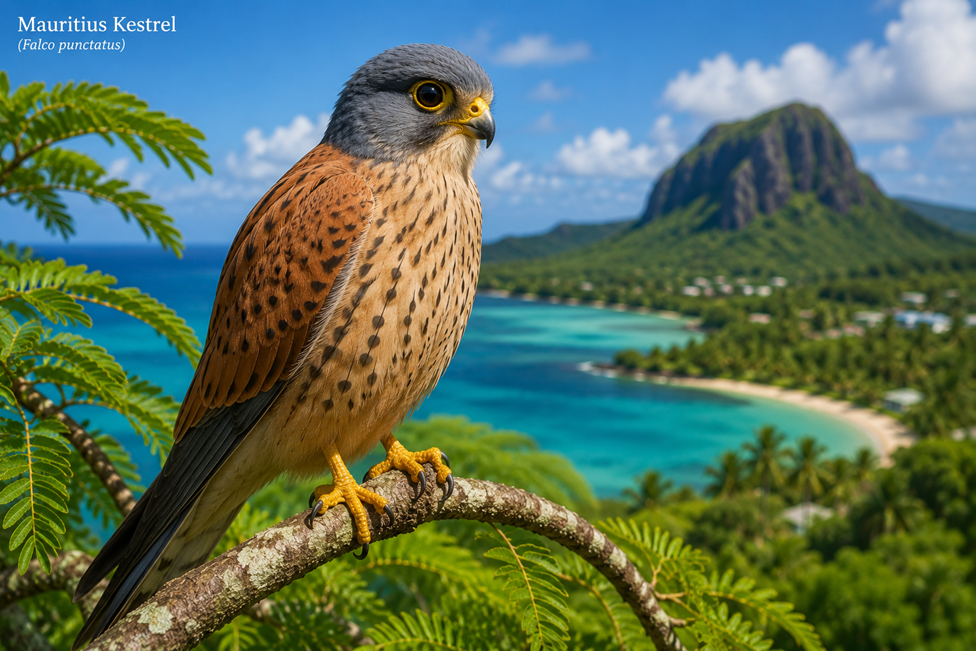
Mauritius Kestrel
A small forest falcon with an extraordinary story: the Mauritius Kestrel became one of the world's most influential examples of determined species conservation.
- The species occurs naturally only in Mauritius
- It is adapted to woodland and forest-edge hunting
- Geckos and insects form an important part of its diet
- Its decline was linked to habitat loss and introduced predators
- Its recovery became a global conservation reference
A bird with global significance
Why the Mauritius Kestrel matters far beyond one island
The Mauritius Kestrel is not the largest or most colourful bird on the island. Its importance lies in what its survival represents.
Habitat loss, introduced predators and chemical pressure reduced the species to a critically small population during the twentieth century. Conservationists responded with nest protection, breeding support, predator management and long-term habitat work.
The programme demonstrated that even a species close to extinction may recover when scientific knowledge is combined with persistent fieldwork.
Identification
What the Mauritius Kestrel looks like
Its compact build and woodland behaviour distinguish it from kestrels commonly associated with open farmland and grassland.
Warm brown plumage
Brown upperparts and paler underparts provide effective camouflage against branches, bark and forest light.
Compact falcon shape
A hooked bill, strong feet and an alert posture reveal a specialised woodland predator.
Quiet forest presence
The bird may remain perched and partially hidden before making a short, precise hunting flight.
Behaviour and ecology
A kestrel adapted to forests
How it hunts
- Uses branches and exposed perches to scan the habitat
- Moves through forest edges and wooded valleys
- Launches short attacks toward prey among trees
- Relies on excellent vision and precise flight
- Uses open patches within woodland as hunting space
What it eats
- Geckos and other small reptiles
- Large insects and invertebrates
- Small birds where opportunities arise
- Other small prey found in woodland habitats
- Species available within its territory
Causes of decline
Why the species came close to extinction
Loss of native forest
Logging, agriculture and development reduced the connected woodland needed for hunting and breeding.
Introduced predators
Rats, mongooses and other non-native animals increased pressure on eggs, chicks and adult birds.
Chemical pressure
Agricultural chemicals added reproductive stress to an already vulnerable population.
Recovery programme
How conservationists rebuilt the population
The recovery required several methods working together over many years.
Nest monitoring
Breeding territories were watched closely so risks could be detected early.
Breeding support
Eggs and chicks were managed when necessary to improve survival.
Predator management
Risks from introduced animals were reduced around important nests.
Habitat protection
Forest and hunting landscapes were maintained and restored.
Recovery does not mean the work is finished
A population can increase while remaining vulnerable to habitat loss, disease, predators and environmental change.
The Mauritius Kestrel continues to depend on suitable forest, protected territories and careful monitoring.
Its story should therefore be understood as a long-term conservation commitment rather than a completed rescue.
Seeing the kestrel
Responsible birdwatching in Mauritius
Recommended behaviour
- Use binoculars or a telephoto lens
- Remain on established paths
- Keep groups small and quiet
- Follow guidance from conservation staff
- Allow the bird to choose its own distance
What visitors should avoid
- Approaching active nests
- Repeated playback of recorded calls
- Blocking a bird's flight path
- Sharing precise nest locations publicly
- Chasing the bird for a closer photograph
Frequently asked questions
Mauritius Kestrel
Where can the Mauritius Kestrel be seen?
The best chances are in protected forest landscapes and conservation-managed areas. A knowledgeable local guide can improve the likelihood of a responsible sighting.
Is the Mauritius Kestrel still rare?
Its population recovered significantly from its lowest point, but the species remains dependent on suitable habitat and continued conservation.
How is it different from European kestrels?
The Mauritius Kestrel is strongly adapted to woodland and forest-edge hunting, while many familiar kestrels are associated with open landscapes.
What does the Mauritius Kestrel eat?
Its diet includes geckos, insects, small birds and other small prey found in woodland habitats.
Can visitors photograph the bird?
Yes, provided photography is conducted from a respectful distance without approaching nests, blocking movement or using repeated call playback.
Why is the species famous?
Its recovery from an extremely small population became one of the most influential examples of modern bird conservation.
Discover the wild side of Mauritius
Explore forests, endemic wildlife, landscapes and practical information in our comprehensive English Mauritius guide.