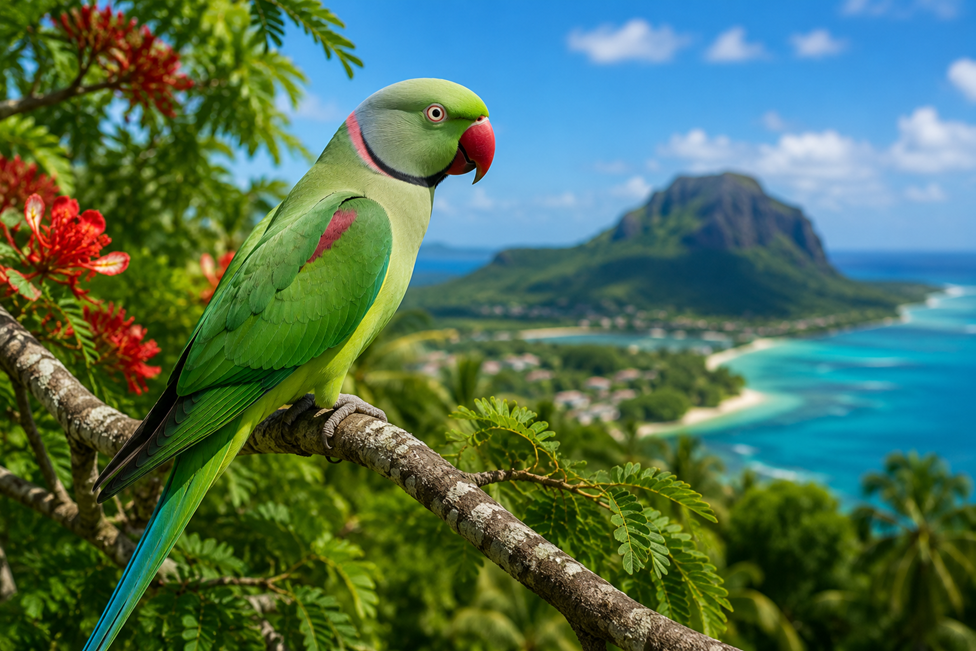
Echo Parakeet in Mauritius
Mauritius' only surviving native parrot is a vivid symbol of island evolution, native forest restoration and one of the world's most remarkable bird conservation recoveries.
- The species occurs naturally only in Mauritius
- It is the island's only surviving native parrot
- Native forest provides food and nesting cavities
- Calls often reveal the bird before it is seen
- Its recovery still depends on active conservation
A forest specialist
The Echo Parakeet is inseparable from Mauritius' native forests
The Echo Parakeet evolved in isolation within the forests of Mauritius. Its green plumage blends almost perfectly with leaves, making the bird surprisingly difficult to see even when it is feeding nearby.
Loud contact calls often reveal the species before it becomes visible. Pairs and small groups move through the canopy, searching for fruits, seeds, flowers and young plant material.
Forest loss, competition for nesting cavities, introduced predators and reduced food availability pushed the species dangerously close to extinction.
Identification
How to recognise the Echo Parakeet
Plumage, bill colour, long-tailed flight and distinctive calls help separate the species from introduced parakeets.
Emerald-green plumage
The predominantly green body provides excellent camouflage among native forest leaves.
Long pointed tail
The elongated tail creates a graceful silhouette during fast, direct flight through valleys and forest openings.
Powerful curved bill
The strong bill is adapted for handling seeds, fruits, flowers and other forest food.
Diet and behaviour
Life in the forest canopy
What Echo Parakeets eat
- Native fruits and berries
- Seeds and young plant material
- Flowers, buds and leaves
- Seasonal food from mature forest trees
- Supplementary food at selected conservation sites
How the birds use the forest
- Travel through the canopy in pairs or small groups
- Use mature trees for natural nesting cavities
- Move between feeding areas according to season
- Communicate with frequent contact calls
- Depend on connected woodland for safe movement
Causes of decline
Why the species came close to extinction
Forest loss
Logging, agriculture and development reduced the mature woodland needed for food and breeding.
Nest-site competition
Suitable tree cavities became limited and were also occupied by introduced birds and other animals.
Introduced predators
Rats, monkeys and other non-native mammals increased pressure on eggs, chicks and nesting adults.
Conservation recovery
How the Echo Parakeet population was supported
The recovery programme combined direct species management with forest restoration and long-term scientific monitoring.
Nest monitoring
Breeding cavities were checked so threats and failures could be identified early.
Nest improvement
Natural cavities and nest boxes were managed to increase safe breeding opportunities.
Predator control
Introduced mammals were managed around important nesting territories.
Food and habitat support
Native planting and supplementary feeding supported birds during periods of limited natural food.
Recovery does not remove the need for protection
The Echo Parakeet is one of Mauritius' most celebrated conservation stories, but the species remains dependent on suitable forest, nesting cavities and active management.
Native woodland remains fragmented. Invasive plants continue to compete with indigenous vegetation, while introduced animals remain present across the wider landscape.
Continued monitoring allows conservation teams to respond before local problems develop into another serious decline.
Where visitors may see them
Birdwatching in south-west Mauritius
Black River Gorges
Protected forest landscapes provide some of the best opportunities to hear and observe Echo Parakeets.
Restored native forest
Conservation-managed woodland provides food, nesting habitat and valuable ecological interpretation.
Guided birdwatching
Local guides recognise calls, feeding areas and seasonal movement while helping visitors avoid sensitive locations.
Responsible observation
How birdwatchers can reduce disturbance
Recommended behaviour
- Remain on marked trails
- Use binoculars or a telephoto lens
- Keep groups small and quiet
- Follow guidance from conservation staff
- Allow birds to move naturally through the canopy
What visitors should avoid
- Approaching active nest cavities
- Repeated playback of recorded calls
- Blocking feeding or flight routes
- Feeding birds without authorisation
- Sharing precise nest locations publicly
Frequently asked questions
Echo Parakeet in Mauritius
Is the Echo Parakeet found outside Mauritius?
No. The species occurs naturally only in Mauritius and is one of the island's most important endemic birds.
Where can Echo Parakeets be seen?
The best opportunities are in protected and restored forests of south-west Mauritius, particularly with a knowledgeable local guide.
How can visitors recognise the species?
Look for green plumage, a long pointed tail, fast direct flight and loud contact calls from the forest canopy.
What does the Echo Parakeet eat?
Its diet includes fruits, seeds, flowers, buds, leaves and other plant material available within native forest.
Why did the species become endangered?
Major pressures included forest loss, limited nesting cavities, introduced predators, competition and reduced natural food.
Is the conservation programme finished?
No. The species recovered significantly, but habitat restoration, monitoring and predator management remain important.
Can visitors photograph nesting birds?
Photography should remain at a respectful distance and must not obstruct or disturb birds using nest cavities.
Discover Mauritius' extraordinary endemic wildlife
Explore forests, conservation stories, island life and practical information in our comprehensive English Mauritius guide.